Part One of Two on AI and the Economic Impacts on Labor and a functioning Gov P&L
ARTIFICIAL INTELLIGENCE • ECONOMICS • THE FUTURE OF WORK
The Paradox of Efficiency
Why Jeff Bezos’s AI “Labor Shortage” Thesis Misdiagnoses the Mechanics of the Cognitive Automation Era
A VerusEdge Strategic Intelligence Briefing | June 2026
Idea in Brief
The Provocation. Speaking at VivaTech in Paris on June 17, 2026, Jeff Bezos dismissed fears of AI-driven unemployment and predicted the opposite: a structural labor shortage. He likened AI to the plow—an invention that ultimately created more work than it destroyed.
Why It’s Wrong. The plow analogy assumes elastic demand, multi-decade adjustment runways, and a fast-growing population. All three held during prior industrial revolutions. None hold today. The result is not mass occupational extinction but a quieter, more dangerous outcome: a permanent contraction in the volume of human labor each unit of output requires.
What Leaders Should Do. Stop treating headcount as a proxy for capability. Re-architect roles around AI leverage, track the indicators that would confirm or falsify this thesis, and plan talent strategy against compounding 3-, 5-, and 10-year contraction scenarios—before competitors capture the efficiency dividend first.
Executive Summary
At the VivaTech conference in Paris on June 17, 2026, Amazon founder Jeff Bezos offered a confident counter-narrative to the prevailing anxiety over artificial intelligence. Dismissing claims of imminent mass technological unemployment, Bezos predicted that AI would not make humans redundant but would instead trigger a widespread, structural labor shortage. Drawing a parallel to the invention of the agricultural plow, he argued that civilization-defining inventions always expand total human wealth, introduce new capabilities, and lower barriers to creation—ultimately uncovering, in his words, an “endless” set of things to do.
It is a reassuring thesis. It is also, on close inspection, the wrong one. A rigorous examination of modern macroeconomics, historical industrial transitions, and current empirical metrics—including the GDPval benchmark and Amazon’s own automation trajectory—indicates that Bezos is misdiagnosing the mechanics of this particular revolution. The structural risk is not a science-fiction apocalypse in which entire occupations vanish overnight. It is an unprecedented contraction in labor demand driven by an exponential leap in unit-labor efficiency.
When AI and advanced robotics make a task dramatically faster and cheaper to execute, the human headcount required to satisfy a given level of output shrinks. Unlike past industrial revolutions, we lack the safety valves of hyper-demographic growth and multi-decade absorption horizons. The disagreement with Bezos is therefore not about whether AI creates economic value—it plainly does—but about who captures that value, and how quickly labor markets can adjust. This briefing deconstructs the “labor shortage” thesis, fairly examines its strongest form, and maps a compounding 3-, 5-, and 10-year horizon for global enterprise labor.
1. The Flaw in the “Plow Analogy”: Elastic vs. Inelastic Labor Demand
Bezos’s core thesis rests on induced demand: lowering the cost of an output increases total consumption of it, ultimately requiring more collective labor to satisfy a newly enlarged market. The plow let fewer people farm a single acre, but it vastly expanded total cultivated land and enabled early civilization to scale. The optimists’ favorite modern illustration is the automated teller machine: by lowering the cost of operating a bank branch in the 1970s and 1980s, the ATM let banks open far more branches and actually increased the absolute number of human tellers for decades afterward.
The ATM story is real, and it is the strongest card in the optimist’s hand. But it works only because two conditions held: demand for branch banking was highly elastic (cheaper branches produced many more branches), and the teller’s role was redefined faster than it could be eliminated. Neither condition is guaranteed—and for most modern knowledge and logistics work, neither holds.
Modern cognitive and physical automation operates on fundamentally different elasticities. For many core tasks—processing insurance claims, generating compliance documentation, managing regional warehouse inventory—demand is relatively inelastic. If a corporation can perform those tasks 10 to 50 times faster using an autonomous AI agent or a humanoid robot, it does not scale its operational footprint fifty-fold. It hits the natural ceiling of its total addressable market and optimizes for margin instead.
Consequently, the labor dynamic shifts from complementation to substitution. AI need not eliminate 100% of an occupation’s responsibilities to destabilize employment. If a frontier model automates 60% of an analyst’s or customer service representative’s daily tasks, a department that once required ten people can operate with four. The job category technically survives. Total labor demand is crushed.
2. Modern Safety Valves Are Failing: Demographic Contraction vs. Historical Hyper-Growth
Techno-optimists frequently overlook the unusually favorable conditions that cushioned prior transitions. What saved the U.S. economy from structural labor collapse during the mechanization waves of the 19th and 20th centuries was that population and market demand were expanding at exponential rates. Consider the defining windows:
• 1830–1880: Mechanized manufacturing and rail met a westward-expanding U.S. population that grew from roughly 12.8 million to over 50 million, continuously generating organic demand for new industries.
• 1889–1915: Heavy industrialization and electrification coincided with the second industrial revolution and historic immigration, expanding domestic consumer markets rapidly.
• 1915–1955: Assembly lines, automotive transport, and early chemical engineering were absorbed by a post-war boom and a surging population.
• 1955–2000: The computing and early-internet revolution unfolded as the Baby Boomer generation entered its peak spending years, fueling an insatiable consumer economy.
In each era, even when innovation sharply reduced the labor required per unit of output, the aggregate volume of units demanded by an exploding population expanded fast enough to offset displacement and seed entirely new sectors. Today the demographic reality is reversed. The United States and virtually all developed nations face historic slowdowns, sub-replacement fertility, and aging populations. The hyper-growing domestic consumer engine that once absorbed displacement is gone. Efficiency gains will increasingly translate directly into headcount reductions rather than expanded output.
Counterpoint: “But Aging Societies Need AI”
The strongest objection to this section turns it on its head: if populations are shrinking, won’t we need AI and robots simply to maintain output—exactly the “labor shortage” Bezos describes? The objection is partly correct, and that is precisely the danger. Labor shortage and labor displacement are not mutually exclusive; they occur in different sectors at the same time.
Genuine, durable shortages concentrate in hands-on, hard-to-automate work—eldercare, skilled trades, nursing, in-home services. The displacement lands on exactly the cognitive and routine-logistics roles AI automates best, and on the entry-level rungs where workers traditionally begin careers. An economy can run a desperate shortage of home-health aides while shedding hundreds of thousands of junior analysts. “There is more total work to do” is cold comfort to a 24-year-old whose on-ramp just disappeared, or a 48-year-old paralegal who cannot retrain into geriatric nursing overnight.
3. The Compression of Time: Multi-Decade Transitions vs. Instantaneous Deployment
Prior revolutions granted society the luxury of time—often decades—to adapt, retrain, and absorb disruption. When agricultural mechanization accelerated in the late 19th century, it took nearly seventy years for the U.S. farm workforce to fall from about 40% of total employment to under 5%. That multi-generational runway let older workers age out naturally while their children moved into the emerging manufacturing and service economies of the cities.
Even then, the wounds were severe and uneven. Jobs were frequently killed in one geography and created in another, leaving whole regions crippled for generations. The deindustrialization of the American Rust Belt in the late 20th century is the stark monument: manufacturing hubs decimated by automation and globalized supply chains left communities hurting for decades, because the local workforce could not instantly migrate to coastal service economies.
The AI transition strips away even that brutal runway. Software-driven cognitive automation, large language models, and agentic networks can be deployed across millions of enterprise computers near-instantaneously through a single software update. The transition is measured in years, not decades—breaking corporate retraining cycles and public safety nets simultaneously. A displaced 45-year-old paralegal or database administrator cannot wait two generations for the economy to re-equilibrate; the velocity of replacement outpaces human occupational adaptability.
4. Steelmanning the Optimist: The Case Bezos Should Have Made
Intellectual honesty requires engaging the optimist’s strongest argument, not its weakest. Stated rigorously, the case for optimism rests on four genuinely powerful pillars:
1. The lump-of-labor fallacy. There is no fixed quantity of work in an economy. New capabilities create new categories of demand—roles that did not exist a generation ago (cloud architect, UX researcher, prompt engineer) now employ millions. Predicting the death of work by counting only the jobs we can currently imagine is a recurring analytical error.
2. The Jevons paradox. When a resource becomes radically cheaper, total consumption of it can rise, not fall. If AI makes software, analysis, or legal review nearly free, society may demand vastly more of it—custom software for every small business, legal review for every transaction—re-expanding the work to be done.
3. A two-century track record. Since the Luddites, virtually every confident prediction of technology-driven mass unemployment has been wrong. Employment-to-population ratios rose across two centuries of relentless automation. The base rate for “this time the machines win” is humbling.
4. Bezos’s actual mechanism. His specific claim is subtler than headlines suggest: by elevating individual productivity, AI lets households sustain their standard of living on less labor—allowing, for instance, two-earner households to shift toward one—thereby tightening, not loosening, the labor market.
These are serious arguments, and any honest forecast must concede real uncertainty. Where the optimistic case breaks down is not in its logic but in its hidden assumptions about speed and elasticity. The lump-of-labor rebuttal and the Jevons paradox both require that new demand materialize and that displaced workers retrain faster than automation spreads. For two centuries that condition was met because adjustment took decades and demand was elastic. The novelty of this revolution—detailed in Sections 1 through 3—is that it collapses the adjustment window to a few years while attacking inelastic, ceiling-bound categories of demand. The optimists are not wrong about the destination; they are wrong about the transition. And it is the transition—lasting perhaps a decade—in which careers, communities, and political stability are made or broken.
5. Hard Data: The GDPval Benchmark
To move past speculative theory, consider GDPval—a benchmark released by OpenAI in September 2025 and now tracked closely by institutional analysts and AI labs. Unlike academic or trivia-style baselines such as MMLU or GSM8K, GDPval evaluates AI on real-world, economically valuable professional deliverables.
The benchmark spans 44 knowledge-work occupations across the nine largest sectors of U.S. Gross Domestic Product—including finance, healthcare, legal services, and engineering—and comprises 1,320 tasks, each built by an industry professional averaging 14 years of experience. The occupations covered represent over $3 trillion in annual U.S. wages, and each task took a human expert an average of roughly seven hours to complete. Deliverables include financial models, policy documents, CAD designs, and enterprise software architectures.
The findings are sobering for knowledge workers. OpenAI reports that frontier-model performance on GDPval is improving roughly linearly over time, with the best current systems approaching expert quality in blind, head-to-head evaluations. In OpenAI’s testing, Anthropic’s Claude Opus 4.1 produced work rated as good as or better than human experts in just under half of tasks, and performance from GPT-4o to GPT-5 more than tripled in a single year. The operational bottleneck is no longer model capability; it is enterprise deployment speed.
A Necessary Caveat on the “100× Cheaper” Claim
OpenAI found that frontier models can complete GDPval tasks roughly 100× faster and 100× cheaper than human experts. That figure is easy to over-read. It reflects pure model inference time and API billing rates only—it excludes the very real costs of human oversight, error correction, integration, and the residual share of tasks models still fail. The honest reading is not “labor cost falls to zero,” but that the marginal cost of a competent first draft is collapsing toward zero, shifting scarce human work toward judgment, verification, and exception-handling. That shift is exactly what compresses headcount without eliminating the function. Having said that even a net 20x impact is huge.
6. The Amazon Contradiction: Robotics and Headcount Optimization
Bezos’s current venture, Project Prometheus—a secretive, multi-billion-dollar AI lab co-founded in November 2025 to build what its founders call an “artificial general engineer” for designing and manufacturing physical products—stands in revealing contrast to his VivaTech optimism. By mid-2026 Prometheus had reportedly raised more than $18 billion (a $6.2 billion launch followed by a $12 billion round at a roughly $41 billion valuation), underscoring how seriously its backers take the automation of engineering itself. But the clearest counter-argument to Bezos is the operational history of the company he built.
Over the past decade Amazon has aggressively deployed automation across its fulfillment and logistics networks—from early Kiva wheeled units to advanced robotic manipulation arms such as Sparrow, and into field testing of agile humanoid systems like Agility Robotics’ Digit. Public messaging has historically framed robotics as merely “assisting” human workers. The financial and headcount metrics tell a different story:
• Corporate trimming. Alongside heavy internal investment in generative AI for software, compliance, and operations, Amazon has cut roughly 30,000 corporate roles—about 10% of its white-collar workforce—with leadership explicitly citing AI-driven efficiency as a central factor.
• Fulfillment economics. Systems like Sparrow—able to autonomously detect, select, and handle millions of unique items via computer vision and tactile AI—directly target the core task of the warehouse picker. The stated goal is to compress the “click-to-ship” cycle while structurally decoupling output from human headcount.
“The objective of modern industrial robotics and corporate agentic workflows is no longer to make the individual worker more productive. It is to make the enterprise system so hyper-efficient that the requirement for human presence within the operational loop is systematically minimized.
There is a second, sharper irony worth naming. Bezos delivered his optimism at the very moment the labor data turned against it—a point critics were quick to make. As the next section shows, the macro signals are no longer hypothetical.
7. The 2026 Signal: What the Labor Data Already Shows
The most striking feature of Bezos’s VivaTech remarks is what they omit. As of mid-2026, the early evidence does not resemble an emerging labor shortage; it resembles the leading edge of the contraction described here:
• Tech-sector layoffs exceeded 115,000 through May 2026, already approaching the full-year 2025 total—with Meta, Amazon, and Snap among employers explicitly citing AI as a driver.
• AI was named the single largest cause of cuts. Of the 97,000-plus U.S. job cuts recorded in May 2026, employers attributed roughly 37,500—about 40%—directly to AI, according to outplacement-firm tracking.
• Goldman Sachs estimates AI is eliminating on the order of 16,000 U.S. jobs per month, with entry-level and Gen Z workers absorbing the heaviest impact—precisely the career on-ramps a healthy labor market depends on.
None of this proves the ten-year forecast correct; cyclical and AI-driven effects are genuinely hard to disentangle, and some cuts will reverse. But it does shift the burden of proof. The optimistic thesis asks us to trust a historical pattern while the contemporary data trends the other way. A forecast that cannot engage the numbers in front of it is faith, not analysis.
8. The Compounding Horizon Scenarios
To help leaders and policymakers navigate the shift, we outline a three-phase, compounding horizon based on current GDPval progression rates and humanoid-robotics commercialization timelines. The figure below illustrates the cumulative effect on knowledge-worker headcount per unit of revenue.
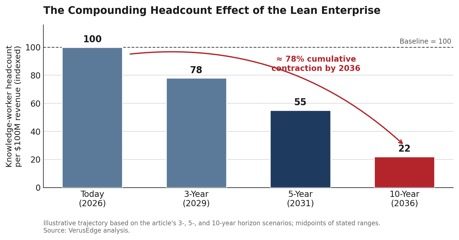
Figure 1. Illustrative compounding contraction in knowledge-worker headcount per $100M of revenue, indexed to 2026 = 100. Midpoints of the article’s stated horizon ranges. Source: VerusEdge analysis.
Figure 1. Illustrative compounding contraction in knowledge-worker headcount per $100M of revenue, indexed to 2026 = 100. Midpoints of the article’s stated horizon ranges. Source: VerusEdge analysis.
The 3-Year Horizon (2029): Selective Consolidation and Friction Points
• Corporate operations. Entry-level white-collar roles—junior analysts, paralegals, content producers, customer-care specialists—enter intense consolidation. Backed by domain-specific agents, a single “super-manager” oversees workloads that once required a ten-person department.
• Blue-collar & logistics. Next-generation humanoid and specialized logistics robots reach commercial cost-parity with human wages in major tier-1 hubs. New facilities are engineered around fully automated zones, cutting the blended labor-to-square-foot ratio by roughly 20–30%.
• Labor-market impact. A sharp bifurcation emerges: strategic managers and technical specialists command intense wage premiums, while entry-level white-collar and routine warehouse hiring stalls, producing structural underemployment among younger workers.
The 5-Year Horizon (2031): The “Lean Enterprise” Equilibrium
• Corporate operations. Deep agentic integration becomes the baseline. For every $100M in revenue, required permanent knowledge-worker headcount contracts 40–50% versus historical benchmarks. Autonomous tooling compresses design-to-manufacturing pipelines from months to days.
• Blue-collar & logistics. General-purpose robotics reach commercial scale across secondary supply chains, light manufacturing, and retail. Remaining human roles shift to exception-handling and safety compliance.
• Labor-market impact. A permanent contraction in aggregate labor demand forces a macroeconomic and political reckoning. Central banks confront structural unemployment that rate policy cannot solve, triggering debate over capital-gains reform and Universal Basic Income.
The 10-Year Horizon (2036): The Sovereign-Efficiency Paradigm
• Corporate operations. The multi-layered hierarchy flattens almost entirely. Multi-billion-dollar micro-enterprises operate globally, run by skeleton teams of executives orchestrating interlocking webs of autonomous AI.
• Blue-collar & logistics. Fully autonomous supply chains run end-to-end, from extraction to last-mile robotic delivery. Routine human labor becomes an expensive anomaly; unions transition toward advocacy for capital-ownership equity rather than wage bargaining.
• Labor-market impact. Productivity decouples from human labor hours. Global GDP reaches record highs on hyper-efficiency, but the central challenge shifts from production to distribution and wealth taxation, and the definition of employment is permanently rewritten.
Leading Indicators: What Would Confirm—or Falsify—This Thesis
A forecast worth trusting states in advance what would prove it wrong. Executives and policymakers should track these signals over the next 24–36 months:
Signals that CONFIRM the contraction thesis:
• Entry-level and new-grad job postings keep declining even as corporate profits rise.
• GDPval (and successor benchmarks) continue their roughly linear climb past expert parity.
• Humanoid-robot total cost of ownership crosses below regional warehouse wages.
• Revenue-per-employee at AI-forward firms diverges sharply from the market.
Signals that would FALSIFY it:
• Net new job categories emerge fast enough to re-absorb displaced workers within 2–3 years (not decades).
• Aggregate labor-force participation holds steady as AI adoption accelerates.
• Wage growth broadens rather than bifurcating between an AI-leverage elite and everyone else.
• Jevons-style demand expansion visibly re-expands knowledge work via surging net-new AI-adjacent headcount.
9. Strategic Conclusion: Navigating the Lean Era
Bezos’s “labor shortage” hypothesis is comforting and historically familiar, but it fails to account for the velocity, scalability, and cognitive-substitution capabilities of modern AI and robotics. Leaders who build five-to-ten-year talent strategies on the assumption that technology will automatically create an equal or greater number of local jobs in their sector risk a severe structural margin disadvantage—arriving late to an efficiency frontier their competitors have already crossed.
The future belongs to the Lean Enterprise. But “optimize your compute-to-labor ratio” is a slogan, not a plan. Concretely, forward-looking executive teams should:
5. Decouple capability from headcount. Stop using team size as a proxy for ambition or status. Re-baseline every function on output per dollar of combined compute-and-labor, and reward leaders who deliver more with leaner teams.
6. Re-architect roles, don’t just cut them. Redesign jobs around the scarce human work AI cannot do well—judgment, verification, relationship, and exception-handling—and route the routine 60% to agents. The goal is higher-leverage humans, not merely fewer of them.
7. Protect the talent pipeline. If you automate away every entry-level role, you starve your own future senior bench. Deliberately preserve apprenticeship paths even where AI could replace them outright.
8. Stress-test the org against all three horizons. Build explicit 3-, 5-, and 10-year headcount scenarios (Figure 1) into workforce and real-estate planning, and revisit them quarterly against the leading indicators above.
9. Decide deliberately how to spend the efficiency dividend. Efficiency gains can fund layoffs, price cuts, reinvestment, or new lines of business. That choice—not the technology—determines whether your firm becomes smaller or simply more powerful.
10. Engage the externalities early. The political and social backlash to rapid displacement is a business risk. Companies that get ahead of reskilling, transition support, and the public conversation will face a friendlier regulatory environment than those that do not.
The need for human ingenuity, strategic vision, and genuine empathy will not disappear. But the volume of human labor required to manifest that ingenuity in the global economy is poised to contract—permanently, and faster than our institutions are prepared for. The leaders who thrive will be those who plan for the transition Bezos’s optimism elides, rather than the destination on which he and his critics may eventually agree.